
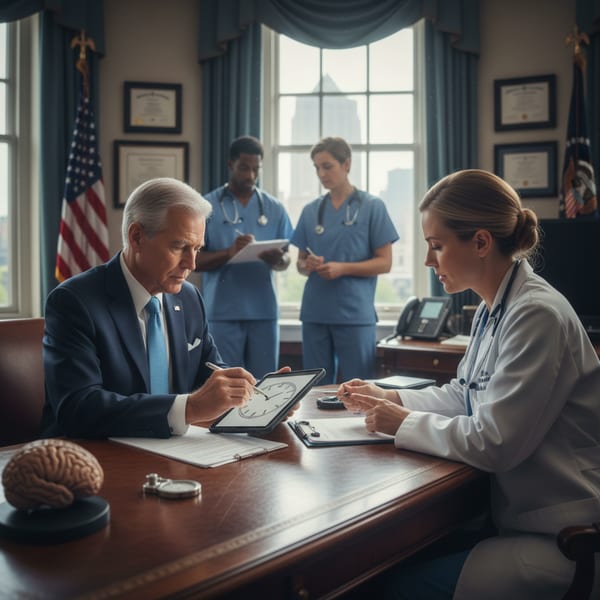
President Donald Trump issued a call for mandatory cognitive testing for all presidential candidates, renewing a debate about age and mental fitness requirements for America’s highest office.
Trump’s Truth Social Declaration
Trump posted the proposal on Truth Social, advocating that every person seeking the presidency should undergo cognitive examination before appearing on ballots. The statement comes as the 2028 election cycle begins taking shape, with both major parties evaluating potential candidates. Trump himself previously touted his performance on cognitive assessments during his presidency, famously discussing his Montreal Cognitive Assessment results in multiple interviews. The renewed push for mandatory testing raises constitutional questions about who determines candidate qualifications beyond the age, citizenship, and residency requirements outlined in Article II.
Trump calls for presidential candidates to take cognitive exams. pic.twitter.com/xr6V6lQ28F
— Sam Smith – Army Ranger Vet (@beachbattranger) April 30, 2026
Constitutional and Practical Concerns
The Constitution establishes only three eligibility requirements for presidents: natural-born citizenship, minimum age of 35, and 14 years of U.S. residency. Any additional requirements would likely require constitutional amendment, a lengthy process demanding two-thirds congressional approval and ratification by three-fourths of states. Legal scholars note that implementing cognitive testing could face significant challenges regarding who administers tests, what standards apply, and whether such requirements could be weaponized against political opponents. The proposal also raises questions about testing current officeholders versus candidates, and whether similar requirements should extend to members of Congress or the Supreme Court.
Political Implications and Reactions
Trump’s announcement generated immediate controversy across social media platforms, with supporters praising transparency in candidate health while critics questioned the timing and motivation. The debate touches broader concerns about gerontocracy in American politics, with the average age of congressional leadership reaching historic highs. Several recent elections featured candidates whose age and health became campaign issues, making cognitive fitness a recurring topic in political discourse. Presidential candidates already face intense medical scrutiny, though disclosure remains largely voluntary rather than mandatory.
What This Means for Future Elections
The proposal highlights ongoing tensions between protecting democratic principles and ensuring candidate capability. While public opinion polling shows majority support for age limits and health assessments for federal officials, implementing such measures faces substantial legal and political obstacles. Trump’s advocacy for cognitive testing may influence Republican primary debates and force Democrats to address similar questions about their potential nominees. Whether this becomes a serious legislative effort or remains political rhetoric will depend on congressional action and public pressure heading into the next presidential cycle.